Part of an ongoing series exploring the hypothesis that Halley’s Comet, and its recurring appearances across recorded history, may lie behind particular figures and episodes in Greek myth. This entry examines Helen of Troy as a candidate case. Nicholas Costa © 2026
Abstract
Helen of Troy is one of the most complex figures in Greek tradition. In Homer she is the mortal woman whose departure from Sparta becomes the immediate cause of the Trojan War. She is also the daughter of Zeus, was worshipped as a goddess at several sites in the Peloponnese, and later receives divine honours, particularly in Sparta.
Across Greek traditions, Helen is defined by extraordinary appearance. She is recognised, desired, blamed, worshipped, and even separated from her own image. The phantom Helen (eidolon) tradition presents a striking paradox: Greeks and Trojans fight over an appearance while the real Helen remains elsewhere.
This study argues that these recurring themes of radiance, disappearance, illusion, and catastrophe preserve elements of an older cultural memory — specifically, memory of a recurring celestial event. It examines Helen’s relationship with a family already recognised by comparative mythologists as inherited celestial imagery, and sets ancient chronological traditions for her generation against the reconstructed return dates of Halley’s Comet. It also situates the argument alongside existing, if non-mainstream, published scholarship that has already proposed a comet apparition during the Trojan War era — though attached to a different figure than Helen.

The case draws on five strands of evidence:
- ancient chronological traditions assigning dates to heroic generations;
- reconstructed appearances of Halley’s Comet;
- environmental disruption during the Late Bronze Age;
- independent religious and comparative-mythological evidence for Helen’s more-than-mortal status;
- the documented ancient practice of reading comets themselves as omens of exactly this kind of appearance-then-catastrophe pattern.
Taken together, these strands make Helen one of the stronger candidates in this series for a mythologised comet memory. The identification is not literal — no ancient source says “Helen is a comet” — but the pattern of evidence is substantial enough to take seriously.
1. Helen: The Woman Whose Appearance Changed History
Few figures in Greek mythology combine beauty, danger, and mystery as strongly as Helen.
In Homer’s Iliad, Helen is a human woman: wife of Menelaus, daughter of Zeus and Leda, and the figure whose departure to Troy becomes the immediate cause of war (Iliad 3.121–160).
Yet Helen is not merely an object of desire. When she appears on the walls of Troy, Priam and the Trojan elders recognise the extraordinary woman whose presence has altered the fate of kingdoms (Iliad 3.154–160).
The central feature of Helen’s myth is appearance. She is the figure whose presence changes history — the same role a bright, unannounced object in the sky plays in the cultures that record it.
2. The Many Forms of Helen
Greek tradition preserved several different versions of Helen.
The Homeric Helen. In Homer she is a mortal woman caught between desire, shame, and responsibility. She understands the suffering caused by the war and expresses sorrow for the consequences surrounding her (Iliad 3.173–176).
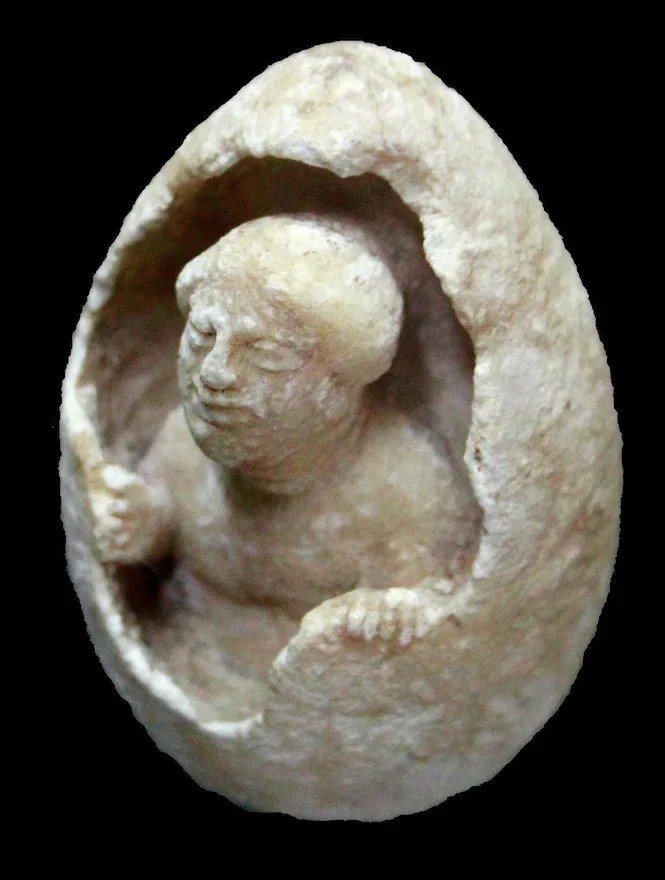
The Divine Helen. Later traditions emphasise her divine ancestry. Helen is commonly presented as the daughter of Zeus and Leda (Apollodorus, Bibliotheca 3.10.7), placing her between human and divine worlds from birth. She was born from an egg laid by her mother Leda who had been seduced by Zeus in the form of a swan.
The Phantom Helen. The most striking transformation is usually associated with Euripides’ Helen (412 BCE), in which Hera creates a phantom image (eidolon) that Paris carries away, while the real Helen waits out the war in Egypt (Helen 33–51). But the idea is older. It appears in the Palinode of the lyric poet Stesichorus (early sixth century BCE): “The tale is not true: you did not go on the well-benched ships and never reached the citadel of Troy” (PMG 192; reported by Plato, Phaedrus 243a, and Republic 586c). Herodotus records a prose version of the same tradition — Helen detained in Egypt while a war was fought at Troy over her absence — a generation before Euripides staged his (Histories 2.112–120).
The eidolon idea therefore runs through Greek lyric, history, and tragedy for the better part of two centuries. This is exactly the kind of persistence a genuinely old, orally-transmitted memory would produce: something happened, or seemed to happen, that Greek storytellers kept needing to explain — an appearance that was not what it seemed, fought over as though it were real.
3. Helen, Light, and Destruction
Ancient interpretations repeatedly associated Helen with exceptional appearance.
The exact origin of her name remains uncertain; ancient writers connected it with brightness and torches, though modern linguistics treats these explanations cautiously.
At the same time, Helen became associated with destruction. In Aeschylus’ Agamemnon, the chorus plays directly on her name in connecting her arrival at Troy to the destruction of ships, men, and cities (Agamemnon 681–689).
The double symbolism — radiance paired inseparably with ruin — is exactly the emotional signature a bright, unexplained celestial visitor followed by disaster would leave on a culture that experienced it. Notably, this is not a modern inference projected backward: it was precisely how the ancient Mediterranean world itself understood comets. The Greek word for comet, kometis (“long-haired,” from komi, “hair”), gave us the modern English term, and Aristotle devoted part of his Meteorologica to comets, associating their appearance with subsequent drought and high winds. Pliny the Elder later catalogued them as stellae crinitae (“hairy stars”) and recorded that a comet visible for seven days after Julius Caesar’s assassination in 44 BC was read by the Roman public as a sign of the ruler’s ascent among the gods (Natural History, on the sidus Iulium). Across the ancient Mediterranean and beyond, comets were consistently read as radiant, unannounced, and predictive of upheaval — war, plague, drought, or the fall of a ruler. Helen’s own symbolic profile — sudden radiant appearance, followed by catastrophe — matches this attested ancient pattern for comets specifically, not merely a generic association between beauty and disaster.

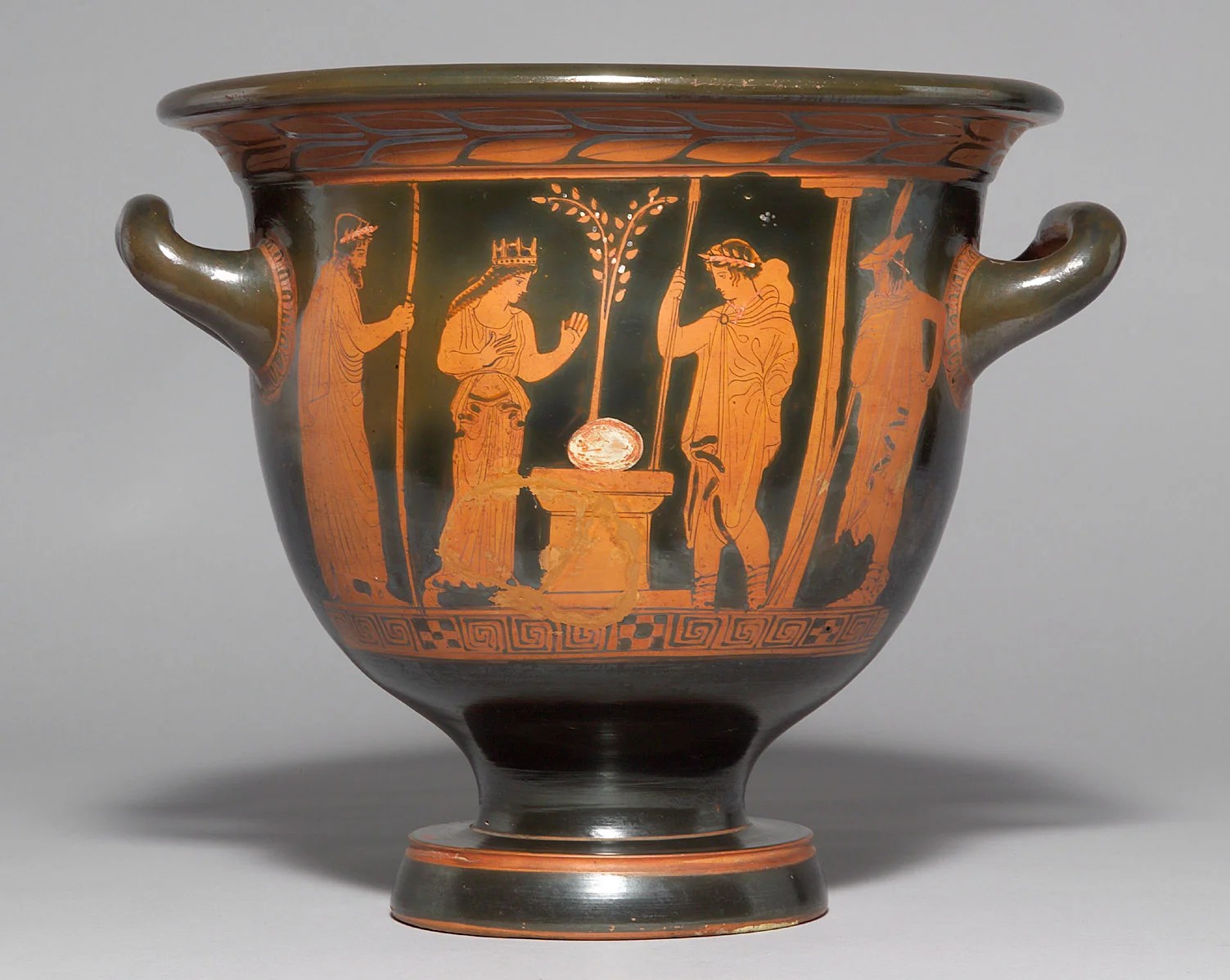
Date Classical, ca. 430–420 B.C. Museum of Fine Arts, Boston
4. Helen and the Celestial Family of Leda
Helen belongs to a family built from celestial imagery.
Her father Zeus is the sky god. Her brothers Castor and Polydeuces become the Dioscuri, associated with the constellation Gemini and with the protection of sailors (Eratosthenes, Catasterisms 10; Hyginus, Astronomica 2.22).
This is not a Greek peculiarity — it is encountered in other cultures. Comparative Indo-European mythology has established a recurring “Divine Twins” mytheme: paired, horse-associated, astral sons of the sky-father, paired with a radiant sister figure, across multiple daughter traditions — the Vedic Asvins and their sister Surya, daughter of the sun; the Baltic Asvieniai/Dieva deli and the Sun Maiden (Saules meita) of Latvian and Lithuanian folk song; and the Greek Dioscuri and Helen (Donald J. Ward, The Divine Twins: An Indo-European Myth in Germanic Tradition, 1968; M. L. West, Indo-European Poetry and Myth, 2007; Mallory and Adams, Encyclopedia of Indo-European Culture, 1997). In the Vedic and Baltic branches the twins are explicit solar rescuers; the Greek version has weakened Helen’s own solar role, but the underlying architecture — sky-father, twin astral brothers, radiant sister — is the same structure.
Helen’s family was celestial before any specific comet chronology entered the picture. That makes her a structurally plausible vessel for celestial memory to attach to, independent of the astronomical argument developed below.

Note the comet above them
5. Helen’s Cult: Independent Religious Evidence
Helen was venerated as more than a literary heroine. The most important site was Therapne, near Sparta — later called the Menelaion — where she was worshipped jointly with Menelaus. Isocrates states that the pair received sacrifices there as gods, not heroes (Encomium of Helen 10.63); Pausanias records the local belief that both were buried at the site (Description of Greece 3.19.9–10); Herodotus separately records a shrine to Helen there and a tale of miraculous transformation worked through her favour (Histories 6.61). Excavation at the site has recovered bronze dedications to Helen and Menelaus dating from as early as the eighth century BCE — centuries before Stesichorus, let alone Euripides.
6. Genealogy and Cultural Memory
Greek genealogies organised more than ancestry — they encoded relationships between heroes, gods, places, and traditions.
The genealogy surrounding Leda is a case in point. Later traditions identify her as the daughter of Thestius, while earlier fragments associated with Eumelus and Alcman link her instead to Glaucus, son of Sisyphus (West, Greek Epic Fragments, 2003). For an analysis of this see the authors article entitled Leda and the Celestial Catastrophe of c. 1284 BC.
7. The Halley Comparison
Yeomans and Kiang reconstructed Halley’s orbital motion back to 1404 BC — the point at which a close Earth encounter and the lack of any older observational anchor limit the model’s reliability (The Long-Term Motion of Comet Halley, 1981). No direct observation of the comet survives from earlier than 240 BC, so everything before that date is computed rather than witnessed.
Set against the chronographic dates above, the alignment is striking:
| Approximate date | Chronographic horizon | Astronomical comparison |
|---|---|---|
| c. 1404 BC | Sisyphus generation | reconstructed Halley passage (outer limit of the model) |
| c. 1334 BC | Phrixus/Athamas/Glaucus generation | reconstructed Halley passage |
| c. 1266 BC | Argonautic generation | reconstructed Halley passage |
| c. 1198 BC | Trojan/Helen horizon | reconstructed Halley passage |
Four successive heroic generations, four successive Halley returns, in step. Neither the ancient chronographers nor Yeomans and Kiang were working with the other’s material — the correspondence, whatever its cause, is not an artefact of a shared source.
9. The 1198 BC Horizon: Climate and Disruption
The Late Bronze Age eastern Mediterranean collapsed under the combined weight of political instability, warfare, economic disruption, migration, earthquakes, and environmental stress.
Manning and colleagues used tree-ring and isotope evidence from Gordion to date an exceptional Anatolian drought to:
1198–1196 BC (±3 years)
(Manning, Kocik, Lorentzen & Sparks, Nature, 2023) — squarely inside the traditional Trojan War horizon, and coincident with the reconstructed Halley passage at the same date. Aristotle’s own theory that comets bring drought and high wind (§3, above) means this specific pairing — a comet followed by severe drought — is not a connection this study is inventing; it is the exact causal link ancient observers themselves drew between the two kinds of phenomena, even if the mechanism they proposed (comets as atmospheric “exhalations”) differs from the modern understanding.
Three independent lines converge on this narrow window: a mythological/chronographic dating tradition, a reconstructed cometary apparition, and a scientifically dated climate shock severe enough to help end an empire. This is the strongest single data point in the case for Helen as a mythologised comet memory.
10. A Precedent: Tree Rings, Comets, and Myth
This general method — using absolutely-dated tree-ring evidence to anchor a link between environmental catastrophe and mythologised memory — has a real precedent. The dendrochronologist Mike Baillie identified narrow-ring “marker dates” clustering around abrupt environmental downturns in long oak chronologies and argued that some of these episodes reflect cometary debris rather than volcanism alone, correlating them with catastrophe narratives in Old Testament, Chinese, and Irish material (Exodus to Arthur: Catastrophic Encounters with Comets, 1999; with Patrick McCafferty, The Celtic Gods: Comets in Irish Mythology, 2005; “Tree-Rings Indicate Global Environmental Downturns that could have been Caused by Comet Debris,” in Bobrowsky and Rickman, eds., Comet/Asteroid Impacts and Human Society, 2006).
The narrow-ring events themselves are directly measured and not in question. Baillie’s specific attribution of particular downturns to cometary debris rather than volcanic or purely climatic causes remains a minority position in archaeology — mainstream treatments, including Manning et al. (2023) above, attribute the 1198–1196 BC drought to ordinary climatic drying. Baillie’s work is cited here as the closest existing methodological parallel to this series’ approach, not as independent proof of a cometary trigger for the Hittite-era drought.
11. Prior Scholarship: A Comet Already Proposed for the Trojan War Era
This series’ Helen hypothesis is not the first attempt to find a Late Bronze Age comet in Homer. In a 2008 book chapter, geologist S. P. Papamarinopoulos argued that a bright comet passage in the twelfth century BC lies behind Homer’s description of Athena appearing to the Achaeans and Trojans as a shining star, whom he identifies with the mythical figure Phaethousa (“A Comet during the Trojan War?”, in Paipetis, ed., Science and Technology in Homeric Epics, Springer, 2008). The same chapter draws on independent Irish and Anatolian tree-ring anomalies dated to 1159 BC and the years following as possible physical traces of the same event.
This is worth flagging honestly on two counts. First, it confirms that the general project of this series — reading a Late Bronze Age comet apparition out of Trojan War-era myth — already exists in published form, which strengthens the case that the underlying idea is not merely this series’ own invention. Second, and just as important: Papamarinopoulos attaches the comet to a different figure (Athena/Phaethousa), not Helen, and his broader framework draws on the “coherent catastrophism” tradition associated with Victor Clube and Bill Napier (The Cosmic Serpent, 1982; The Cosmic Winter, 1990), which remains outside the mainstream consensus in both astronomy and Homeric scholarship. The Helen identification developed in this article should therefore be understood as this series’ own extension of a broader, still-contested research tradition, not as something already established or endorsed by Papamarinopoulos’s work specifically.
12. Odysseus and the Eclipse Question
A related discussion concerns the possible date of Odysseus’ return. In Odyssey Book 20, the seer Theoclymenus describes the sun disappearing and darkness covering the world — read by some as a solar eclipse. Carl Schoch proposed 1178 BC; Marcelo Magnasco and Constantino Baikouzis argued several astronomical references in the poem are consistent with that date (PNAS, 2008). The reading remains debated, and the passage may be poetic rather than observational — but it sits inside the same broad post-Trojan-War generation as the drought and the reconstructed 1198 BC Halley passage, adding a third possible astronomical signature to the same narrow window of Greek epic memory.

Note the cometary image above Helen.
13. Helen as Celestial Memory
Several features of Helen’s tradition read naturally as the residue of a real celestial event, transformed by generations of retelling.
Appearance and Sudden Visibility. Helen is defined by appearance. Her presence before the Trojan elders produces immediate recognition and becomes an event that changes political reality — precisely how a bright, unannounced object in the sky functions in the cultures that witness it, and precisely how ancient writers themselves described the psychological impact of comets (§3).

The Phantom Image. The eidolon tradition — attested from Stesichorus through Herodotus to Euripides — has Greeks and Trojans fighting over a visible form that is not the true Helen. A transient celestial event produces exactly this kind of experience: a powerful appearance that cannot be possessed, held onto, or recovered once it fades.
Beauty and Catastrophe. Helen’s beauty is inseparable from destruction throughout the tradition. The recurring pattern — extraordinary appearance, overwhelming attention, disappearance, catastrophe — is the shape a comet apparition followed by drought and civilisational collapse would leave on the people who lived through it and told the story afterward.
14. The Sun. the Asterite Tradition and the Extraordinary Stone
Late passages preserved by Photius from Ptolemy Hephaestion’s New History state that Helen was a daughter of the sun and Leda. Elsewhere he describes the pan — a monstrous sea creature — as containing an “asterite” stone that caught fire in sunlight; Helen possessed the stone as a seal, engraved with the creature’s image. A stone that ignites in sunlight and belongs to Helen is a natural point of contact with the celestial-memory reading of her myth.
A note on this source’s reliability. Our sole witness, Photius, brands his work as “badly imagined.” Classicists traditionally dismissed Chennus as a myth fabricator. Modern scholars are more forgiving. They argue he compiled obscure, lost local traditions rather than inventing everything. Photius himself admits the more credible tales offer “knowledge above the ordinary.” Therefore, the asterite motif is valuable as a late symbolic elaboration, although it cannot stand alone as independent historical evidence.

15. The Case for Helen as a Halley Memory
Taken individually, none of the following would be conclusive. Taken together, they form the strongest pattern in this series so far:
- Helen is associated with extraordinary appearance, beauty, and catastrophe across independent genres — epic, lyric, tragedy, history — not a single source.
- Her family is paralleled by Indo-European celestial imagery (the Divine Twins / Sun Maiden pattern), independently of any comet hypothesis.
- The phantom-Helen (eidolon) tradition — an appearance fought over that is not the underlying reality — is attested continuously from the early sixth century BCE onward.
- She received cult worship as more-than-mortal from at least the eighth century BCE, confirmed archaeologically.
- Her specific symbolic profile — sudden radiance followed by catastrophe — matches the documented ancient understanding of comets themselves, not a generic literary trope.
- Two related chronographic traditions independently place her generation’s mythic horizon at approximately 1330–1334 BC, and the wider Trojan/Helen horizon at approximately 1198 BC.
- Reconstructed Halley passages fall close to each of four successive heroic generations in this chronology, including 1198 BC.
- A severe, precisely tree-ring-dated drought struck Anatolia in exactly this window (1198–1196 BC) — matching the ancient (Aristotelian) belief that comets themselves bring drought.
- A directly comparable methodology already exists in the dendrochronological literature (Baillie), and a directly comparable conclusion — a Trojan War-era comet in Homer — has already been proposed in print (Papamarinopoulos, 2008), albeit for a different figure and from within a still-contested research tradition.
The proposal is that Helen is yet another metaphor for Halley’s Comet, although no ancient source makes that identification. The proposal is that a dramatic celestial event — plausibly a Halley apparition around 1198 BC, arriving alongside or shortly before a catastrophic multi-year drought — left a mark on Greek cultural memory, and that Helene, (which means “light,” “torch,” or “bright one.”) became established in cult and genealogy as radiant and celestial, was a natural figure for that memory to attach to and be reshaped around over the following centuries.
16. Conclusion
Helen’s tradition combines extraordinary radiance, a celestial family structure paralleled by Indo-European myth, the recurring phantom image, independent cult worship, and a settled pattern of appearance followed by catastrophe that matches, point for point, how the ancient Mediterranean world itself understood comets. Ancient chronological traditions place her generation’s horizon close to a reconstructed Halley passage, at almost exactly the date a severe, independently dated drought struck the region and the Bronze Age world began to unravel — the same causal pairing, comet-then-drought, that Aristotle himself proposed for comets in general.
This is a hypothesis, and it belongs to a series exploring the same idea across several figures in Greek myth, building on a small but real existing literature (Papamarinopoulos, Baillie, Clube and Napier) that has already argued for cometary traces in Bronze Age myth and tree-ring records, even if that literature remains outside the mainstream consensus in classics and archaeology. Of the candidates this series has considered, Helen presents an unusually dense convergence of evidence: comparative mythology, cult practice, literary transmission, chronography, astronomy, ancient comet-lore, and climate science all point toward the same narrow window. The deeper question this series is built around is not whether Helen “was” a comet, but how ancient societies transformed remarkable experiences of the natural world into enduring stories about gods, heroes, and the fate of civilisations — and Helen may be one of the clearest surviving examples of that process at work.
Selected References
Adler, William, and Paul Tuffin. The Chronography of George Synkellos: A Byzantine Chronicle of Universal History from the Creation. 2002.
Aeschylus. Agamemnon.
Apollodorus. Bibliotheca.
Aristotle. Meteorologica, Book 1.
Baillie, M. G. L. Exodus to Arthur: Catastrophic Encounters with Comets. Batsford, 1999.
Baillie, M. G. L. “Tree-Rings Indicate Global Environmental Downturns that could have been Caused by Comet Debris.” In Bobrowsky, P., and H. Rickman, eds., Comet/Asteroid Impacts and Human Society: An Interdisciplinary Approach. Springer, 2006, 105–122.
Clube, Victor, and Bill Napier. The Cosmic Serpent. Faber and Faber, 1982.
Clube, Victor, and Bill Napier. The Cosmic Winter. Basil Blackwell, 1990.
Edmunds, Lowell. “Helen’s Divine Origins.” Electronic Antiquity 10.2 (2007).
Eratosthenes. Catasterisms.
Euripides. Helen.
Helm, Rudolf (ed.). Eusebius Werke, 7. Band: Die Chronik des Hieronymus, Hieronymi Chronicon. 1956.
Herodotus. Histories, Books 2 and 6.
Homer. Iliad.
Homer. Odyssey.
Hyginus. Astronomica.
Isocrates. Encomium of Helen.
Magnasco, Marcelo O., and Constantino Baikouzis. “Is an eclipse described in the Odyssey?” Proceedings of the National Academy of Sciences 105 (2008).
Mallory, J. P., and D. Q. Adams. Encyclopedia of Indo-European Culture. Fitzroy Dearborn, 1997.
Manning, Sturt W., Charlotte Kocik, Brita Lorentzen, and Jed P. Sparks. “Severe multi-year drought coincident with Hittite collapse around 1198–1196 BC.” Nature (2023).
McCafferty, Patrick, and M. G. L. Baillie. The Celtic Gods: Comets in Irish Mythology. Tempus, 2005.
Mosshammer, Alden A. The Chronicle of Eusebius and Greek Chronographic Tradition. 1979.
Mosshammer, Alden A. Georgius Syncellus, Ecloga Chronographica. 1984.
Papamarinopoulos, S. P. “A Comet during the Trojan War?” In Paipetis, S. A., ed., Science and Technology in Homeric Epics, History of Mechanism and Machine Science, vol. 6. Springer, Dordrecht, 2008, 341–356.
Pausanias. Description of Greece, Book 3.
Photius. Bibliotheca, cod. 190 (summary of Ptolemy Chennus/Hephaestion, New History).
Pliny the Elder. Natural History, Book 2 (on comets and the sidus Iulium).
Stesichorus. Palinode, Poetae Melici Graeci (PMG) 192–193.
Ward, Donald J. The Divine Twins: An Indo-European Myth in Germanic Tradition. University of California Press, 1968.
West, M. L. Greek Epic Fragments. Harvard University Press, 2003.
West, M. L. Indo-European Poetry and Myth. Oxford University Press, 2007.
Yeomans, Donald K., and T. Kiang. “The Long-Term Motion of Comet Halley.” Monthly Notices of the Royal Astronomical Society 197 (1981): 633–646.
Leave a Reply