Reconsidering the Myth through Chronology, Genealogy and Celestial Symbolism, by Nicholas Costa © 2026
Abstract
The myth of Leda is among the most recognizable narratives of Greek mythology. Best known as the mother of Helen of Troy and the Dioscuri, she is remembered through the extraordinary account of Zeus approaching her in the form of a swan, resulting in the laying of an egg from which her children emerged. Although traditionally interpreted as a tale of divine transformation and heroic genealogy, the wider traditions surrounding Leda contain a number of unusual features: conflicting genealogies, compressed chronology, and a concentration of names and symbols associated with radiance, striking, destruction, and celestial phenomena.
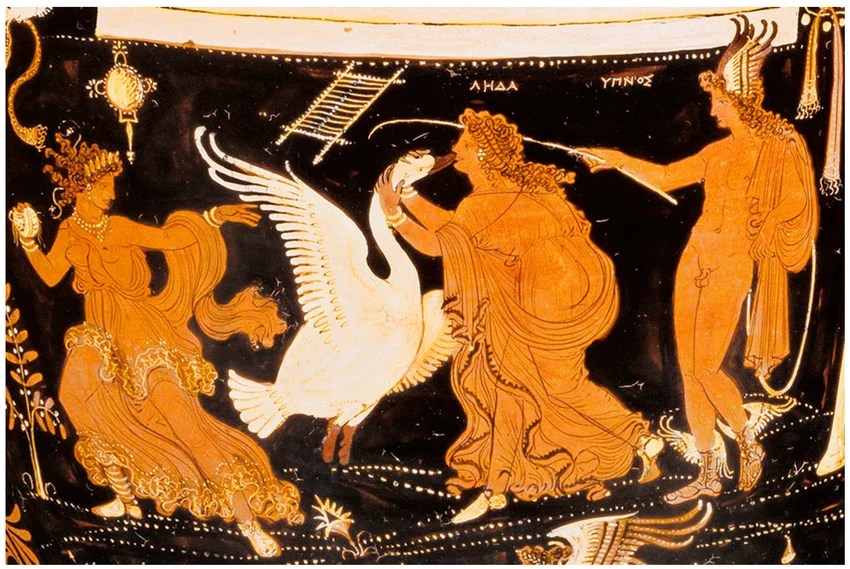
This study proposes that the Leda tradition may preserve the cultural memory of a major celestial catastrophe centred on approximately 1284 BC. Drawing upon early genealogical traditions, ancient chronology, philological evidence, and recurring astronomical symbolism, it argues that the figures surrounding Leda may represent not merely successive generations of heroic individuals but symbolic reflections of extraordinary events observed in the sky.
Particular attention is given to the earliest traditions identifying Glaucus, son of Sisyphus, as Leda’s father rather than the later and more familiar genealogy through Thestius. Within the chronological framework adopted throughout this series of studies, Sisyphus and Glaucus correspond to earlier apparitions of Halley’s Comet, while the events associated with Leda, Tyndareus, Castor, Polydeuces, and Olympia preserve a separate celestial catastrophe occurring around 1284 BC.
The purpose of this study is not to argue that every element of Greek mythology derives from astronomical observation, but rather to examine whether a particular cluster of traditions surrounding Leda preserves a coherent memory of a significant Bronze Age celestial event.
Introduction
Among the women of Greek mythology, few occupy a position as central as Leda. Through her children Helen and Clytemnestra, she becomes connected with the Trojan War and the downfall of the Atreid dynasty; through Castor and Polydeuces, she becomes associated with Sparta, the Argonautic expedition, and ultimately the stars themselves. Yet despite her importance, the traditions surrounding Leda are far from uniform.
Later sources commonly identify Leda as the daughter of Thestius, placing her within the royal traditions of Aetolia. Earlier evidence, however, preserves a different genealogy, linking her instead to Glaucus, son of Sisyphus. These competing traditions are not merely variations in family history; they raise questions concerning the original function of heroic genealogies and whether such traditions may preserve chronological or astronomical information rather than straightforward biological descent.
The present study argues that the Leda tradition should be considered within a wider framework of celestial memory. The central proposition is that a major celestial catastrophe occurred around 1284 BC, an event later transformed into mythological narratives concerning Leda, Tyndareus, the miraculous egg, the Dioscuri, and the related traditions surrounding Pelops and Olympia.
The argument proceeds through several lines of evidence.
First, the chronological traditions preserved by ancient writers reveal difficulties when heroic genealogies are interpreted literally. The interval between Sisyphus, traditionally placed by Eusebius around 1409 BC, and the fall of Troy, traditionally dated by Eratosthenes to 1184 BC, spans approximately 225 years. The limited number of generations used to bridge this period suggests that these genealogies may have served purposes other than recording ordinary human descent.
Secondly, the earliest surviving traditions concerning Leda’s parentage are examined, particularly those connecting her to Glaucus and Sisyphus. Within the chronological framework adopted here, these figures correspond to earlier celestial phenomena, including the Halley’s Comet apparitions of approximately 1404 BC and 1334 BC.
Thirdly, the names and symbolic attributes of Leda’s family are considered. Glaucus, Tyndareus, Gorgophone, Castor, and Polydeuces all preserve associations with brilliance, striking, violence, or stellar imagery. These meanings do not independently establish a celestial interpretation, but they contribute to a broader pattern.
Finally, the traditions surrounding the egg, the eagle and swan, the Dioscuri, and Olympia are examined as possible mythological memories of a major atmospheric event occurring around 1284 BC.
Methodological Note
This study distinguishes between three categories of evidence.
The first consists of ancient literary testimony. These sources include Eumelus’ Corinthiaca, Alcman’s fragments, Apollonius Rhodius and the scholia upon his Argonautica, Homeric traditions, Eusebius’ chronology, and later lexicographical works such as the Etymologicum Magnum. These texts provide the primary evidence for the genealogies, names, and traditions discussed.
The second category consists of modern scholarship, particularly in the fields of Greek linguistics, Indo-European studies, astronomy, and comparative mythology. These works establish the limits of what may reasonably be inferred from the surviving evidence.
The third category consists of the interpretative hypothesis advanced here: that certain mythological genealogies and symbols preserve memories of celestial phenomena. Where this interpretation extends beyond explicit ancient testimony, it is presented as a reconstruction rather than as established fact.
1. The Chronological Problem: Sisyphus, Glaucus and Halley’s Comet
A significant chronological difficulty exists within Greek heroic genealogy.
According to Eusebius, Sisyphus founded Corinth in approximately 1409 BC. The traditional date for the fall of Troy, established by Eratosthenes, is 1184 BC. Between these two dates lies an interval of approximately 225 years.
Greek mythology appears to bridge this period through only four generations. If interpreted literally, this would require successive fathers to reproduce at an average age of approximately fifty-six years, an unusually high figure sustained across multiple generations.
One possible explanation is that these “generations” do not represent ordinary biological succession. Instead, they may preserve a sequence of celestial events.
Within the chronological framework adopted throughout this series, four apparitions of Halley’s Comet correspond to this broader period:
- 1404 BC
- 1334 BC
- 1266 BC
- 1198 BC
Rather than representing literal human generations, these intervals may have been transformed into genealogical relationships. Each “descendant” represents a later event or manifestation connected symbolically to the preceding one.
Within this framework:
- Sisyphus corresponds to the apparition of Halley’s Comet around 1404 BC.
- Glaucus, his son in the earliest Leda traditions, corresponds to the apparition around 1334 BC.
The significance of this interpretation becomes clearer when examining the earliest surviving traditions concerning Leda herself.
2. Leda, Daughter of Glaucus
Later mythographical tradition generally identifies Thestius as the father of Leda. This genealogy became dominant in subsequent Greek literature.
The earliest surviving traditions, however, preserve another account.
According to Eumelus’ Corinthiaca, preserved in the Scholia on Apollonius Rhodius (Argonautica 1.146), Leda was the daughter of Glaucus, son of Sisyphus. The same genealogy is attributed to Alcman (Fragment 4), also preserved in the scholia.
These sources are significant because they demonstrate that the Glaucus genealogy was not a late invention but belonged to an early tradition.
Within the interpretation proposed here, this genealogy is chronological rather than biological. If Sisyphus and Glaucus represent successive celestial phenomena, then Leda’s descent from Glaucus preserves the transition from one event to another.
The later substitution of Thestius may therefore represent a process by which an original celestial genealogy was transformed into a more conventional geological structure.
3. Leda, the Lady
The name Leda has long presented difficulties for Greek etymology. Unlike many heroic names whose meanings appear transparent, Leda does not possess an obvious Greek derivation.
Recent linguistic work by Alexander Nikolaev has proposed that Leda, together with Leto, may derive from the Luwian word lada, meaning “lady” or “woman of status” (Nikolaev, Indo-European Linguistics and Classical Philology 29/2, 2025, 107–136, preprint).
This proposal is significant because Leda and Leto occupy remarkably similar mythological positions. Both are female figures associated with extraordinary births:
- Leda gives birth to Helen, Clytemnestra, Castor, and Polydeuces.
- Leto gives birth to Apollo and Artemis.
The present study extends this linguistic observation in a different direction. If both names preserve an ancient meaning connected with “lady,” it is possible that the figures themselves originally represented not historical women but symbolic female forms associated with celestial phenomena.
Ancient myth frequently describes extraordinary events in biological language. A celestial object entering the atmosphere and breaking apart could naturally be interpreted through the imagery of a female figure giving birth. The appearance of multiple luminous fragments could then become the birth of multiple divine children.
Within this framework, Leda’s famous egg becomes particularly significant. Rather than merely representing a miraculous birth, the egg may preserve an attempt to describe the appearance of a celestial object that fragmented after entering the atmosphere.
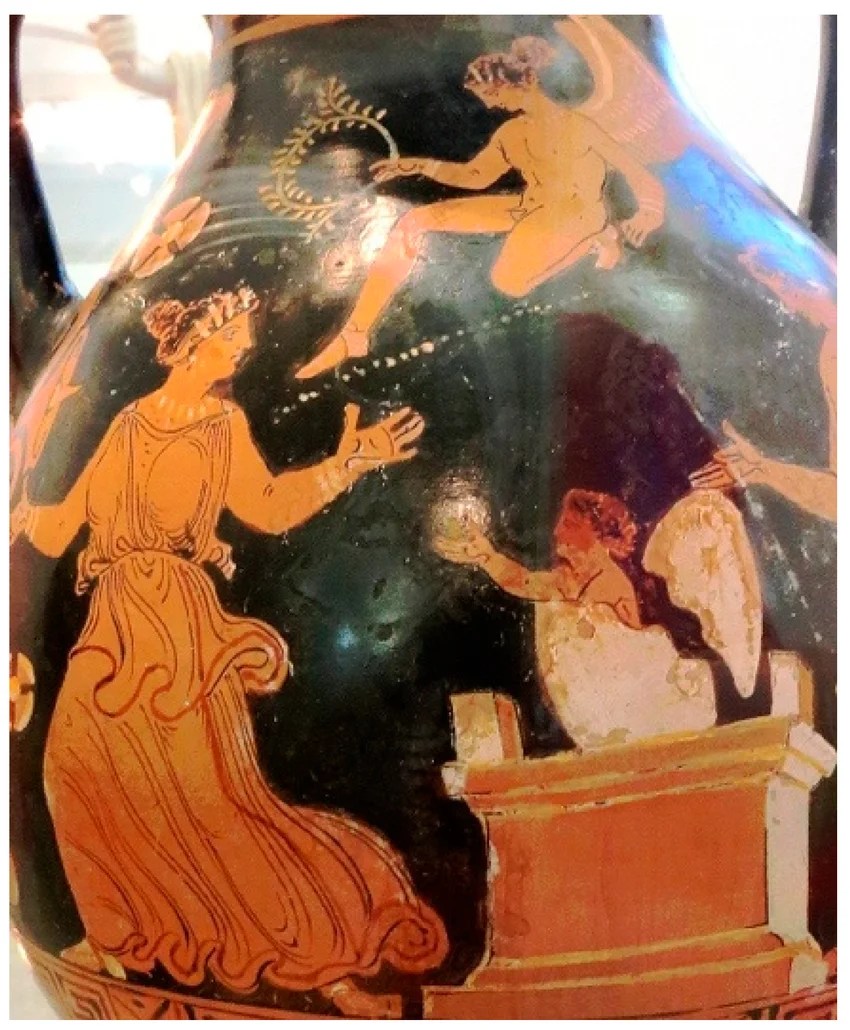
This interpretation does not require that every maternal figure in Greek mythology represents a meteorological event. Rather, it suggests that certain myths of extraordinary birth may have originated from attempts to describe unusual phenomena observed in the sky.
4. Glaucus: The Shining Father of Leda
The figure of Glaucus provides the direct link between Leda and the earlier chronological tradition of Sisyphus.
According to the Scholia on Apollonius Rhodius (Argonautica 1.1280), Glaucus was Leda’s father. This tradition differs from the later identification of Thestius as her father but is supported by early sources including Eumelus and Alcman.
The name itself is also significant.
Ancient Greek linguistic tradition associated Glaucus with brightness and shining. The Etymologicum Magnum explains the name through the archaic Greek verb glausso, meaning “to glow,” “to shine,” or “to flash.”
Whether this represents the historical linguistic origin of the name or an ancient interpretation of it, the association with brilliance is unmistakable.
Within the reconstruction proposed here, Glaucus represents the Halley’s Comet apparition of 1334 BC. A bright and unusual object appearing in the sky would naturally acquire a name connected with radiance.
The mythology surrounding Glaucus also preserves additional imagery consistent with a celestial interpretation.
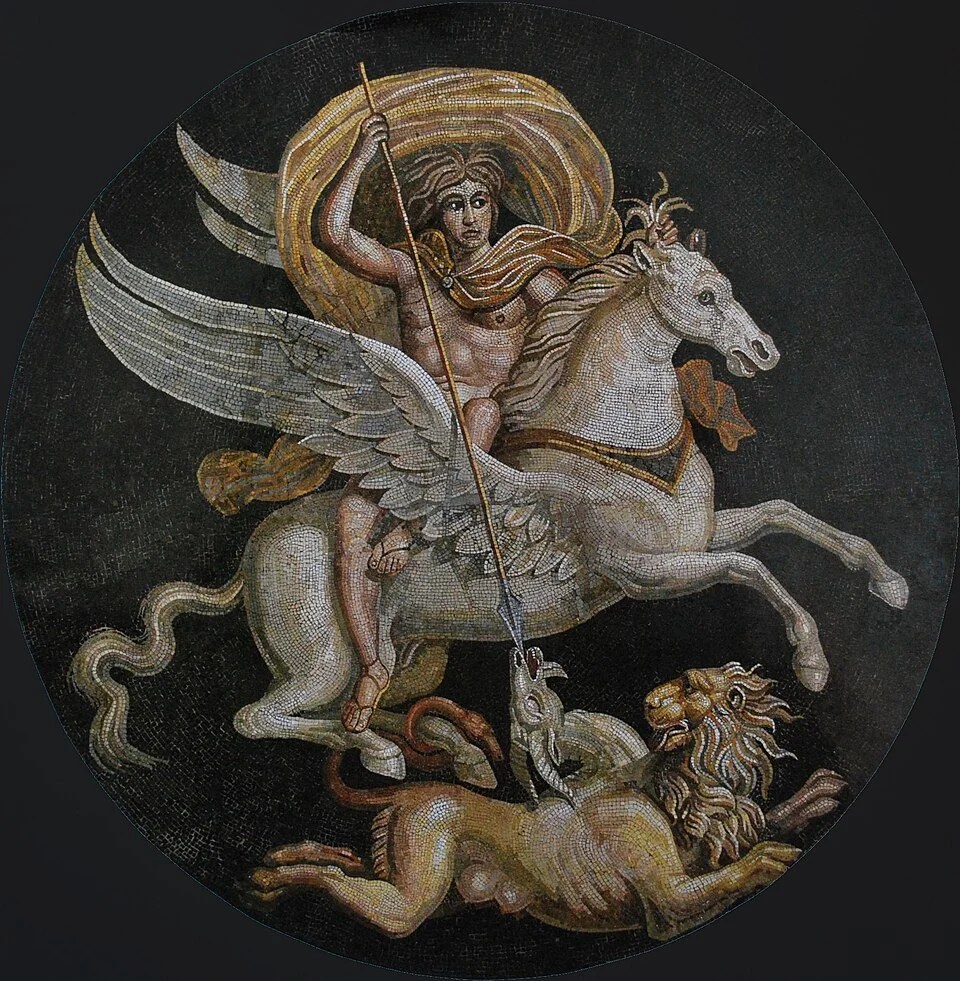
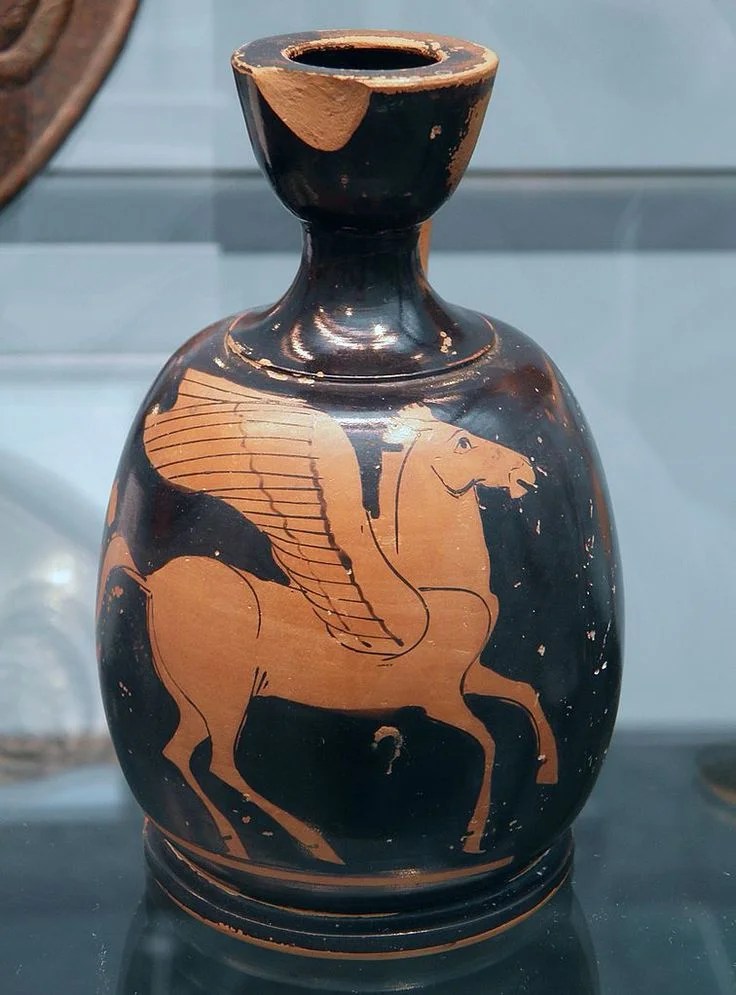
He is remembered as the father of Bellerophon, the hero most famous for taming and riding the winged horse Pegasus. Eusebius places Bellerophon approximately around 1241 BC, within the broader chronological sequence developed in this series.
Glaucus also appears in another unusual episode. According to tradition, shortly after the voyage of the Argo, in the 1260’s, he was destroyed by his own horses.
This episode is striking because horses in Greek mythology often carry symbolic associations with speed, fire, and celestial movement. The idea that Glaucus was consumed by his own horses may preserve a memory of a later atmospheric phenomenon, perhaps an airburst or intense meteor activity.
5. Horses as Cosmic Metaphors
The interpretation of horses as celestial symbols is not unique to the traditions surrounding Glaucus.
Throughout Indo-European mythology, horses frequently represent speed, energy, and the movement of heavenly bodies.
Jaan Puhvel, in Analecta Indoeuropaea: Delectus Operum Minorum (1981), examined how the physical characteristics of the horse—its speed, power, and blazing energy—became associated with solar and stellar imagery. The horse transformed the heavens into a cosmic pathway through which divine and celestial forces travelled.
Similarly, Marina Mili?evi? Brada?, in Greek Mythological Horses and the World’s Boundary (2001), demonstrated that horses in Greek myth frequently occupy a symbolic position between earth and sky. They transport gods and heroes across boundaries between different cosmic realms.
This pattern is especially relevant to the traditions surrounding Glaucus and Bellerophon.
Bellerophon’s association with Pegasus is not simply a heroic tale of animal mastery. Pegasus is a winged horse, a creature explicitly combining terrestrial and celestial qualities. His connection with a hero descended from Glaucus reinforces the broader pattern of luminous and atmospheric imagery surrounding this genealogy.
Within the interpretation proposed here, horses function as part of a wider mythological vocabulary used to describe extraordinary movement through the heavens.
6. Paneidyia: “Visible to All”
The maternal genealogy of Leda also preserves important symbolic elements.
According to Eumelus’ Corinthiaca, preserved in the Scholia on Apollonius Rhodius (Argonautica 1.146), Paneidyia and Glaucus were the parents of Leda.
The name Paneidyia is unusual and has attracted ancient interpretation.
The first element, pan, means “all” or “everything.” The second element has been connected with the root id-, associated with eidos, meaning “form,” “appearance,” or “visible shape.”
Following the interpretative principles discussed in ancient grammatical traditions, including Plato’s Cratylus and scholia upon Homer, the name may therefore be understood as:
“Visible to All.”
The Etymologicum Magnum, a twelfth-century Byzantine compilation preserving earlier grammatical traditions, also records a connection between Paneidyia and Pandeia, the daughter of Selene mentioned in Homeric Hymn 32. Ancient commentators interpreted this name as meaning “All-Bright” or “All-Radiant.”
This is particularly noteworthy within the present interpretation. A celestial event visible over a large area would naturally acquire descriptions emphasizing universal visibility and brightness.
Paneidyia therefore provides another example of a name whose traditional interpretation aligns with the imagery of a visible celestial phenomenon.
7. Laophonte: Destroyer of the People
A different maternal tradition is preserved by Alcman (Fragment 15), who identifies Laophonte as Leda’s mother and Glaucus as her father.
The name Laophonte may be divided into two elements.
The first, laos, means “the people” or “the populace.”
The second element derives from a root connected with theino, meaning “to strike” or “to kill.”
The resulting meaning may therefore be interpreted as:
“Slayer of the People”
“Destroyer of the People”
Although the meaning of the name should not be treated as proof of historical events, it contributes to a recurring pattern within the genealogy surrounding Leda. Where Paneidyia emphasizes visibility and brilliance, Laophonte emphasizes destructive force.
These two traditions are not necessarily contradictory. A large celestial event could simultaneously be:
- visible to all,
- associated with brilliance,
- and remembered for destruction.
The coexistence of these meanings is therefore compatible with the broader interpretation proposed here.
8. Tyndareus: The Striker
Leda’s marriage to Tyndareus introduces another significant name.
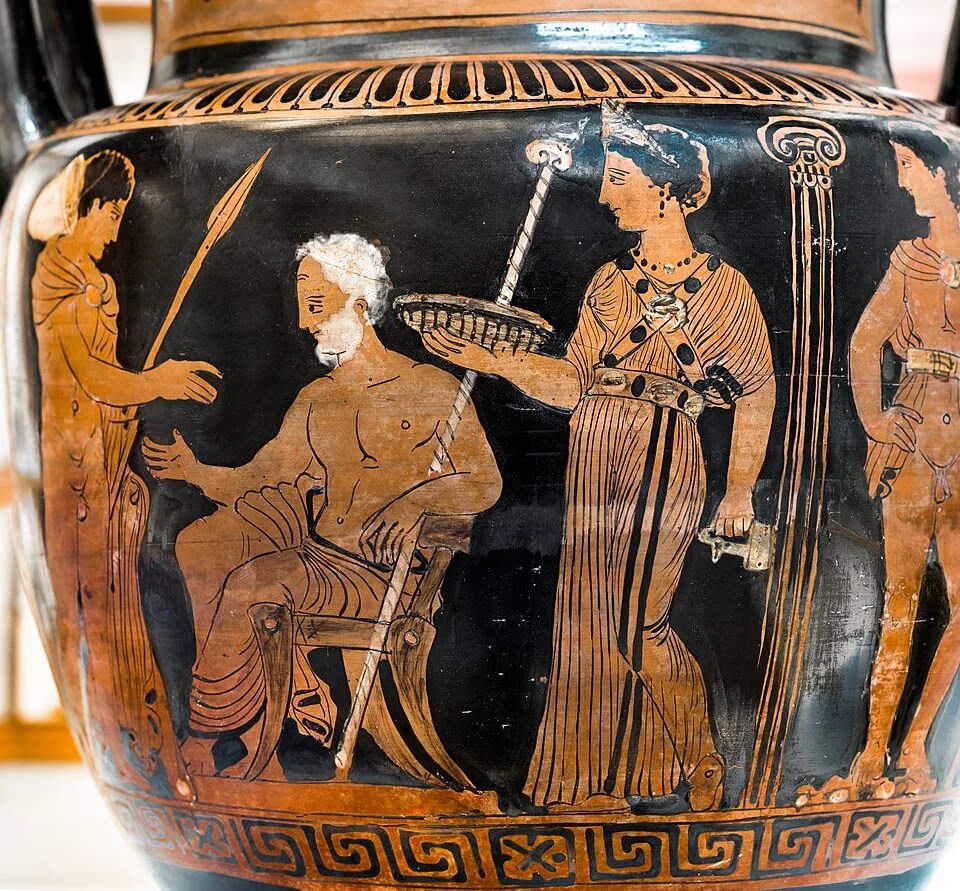
According to Greek mythology, Leda came from Aetolia to Sparta following her marriage to Tyndareus, who became king of Sparta.
Modern linguistic analysis generally connects the name Tyndareus with the Proto-Indo-European root:
*(s)tewd-
meaning “to push,” “to strike,” or “to hit.”
The name may therefore be interpreted as:
“The Striker”
“The Pounder”
“He Who Strikes”
This meaning is notable when considered alongside the other names in Leda’s immediate family.
The genealogy contains repeated associations with:
- striking,
- destruction,
- brilliance,
- movement,
- and celestial visibility.
Tyndareus’ own ancestry reinforces this pattern.
His mother Gorgophone combines:
- gorgos — fierce, terrible, dreadful
- phone — slaughter, killing
The resulting sense is one of terrifying destruction.
Gorgophone’s first husband, Perieres, has traditionally been interpreted as “the one who goes around,” “the encircler,” or “the rover.” The compound may also carry associations of ruin or destruction.
Her second husband, Oebalus, has likewise been interpreted through the elements:
- oios — alone, singular
- ballo — to throw, strike, hurl
producing the possible sense:
“The Singular Striker”
Taken individually, these interpretations remain uncertain. Collectively, however, they create a repeated vocabulary of force and catastrophe.
Within the framework proposed here, these names contribute to the symbolic environment surrounding the central event of approximately 1284 BC.
9. The Eagle and the Swan
The most famous episode connected with Leda is the account of her encounter with Zeus, who approached her after transforming himself into a swan. Later traditions add that Zeus was accompanied by, or first transformed into, an eagle before assuming the form of the swan.
Following this encounter, Leda laid an egg from which her children emerged. Some later authors describe one egg, while others preserve a tradition of two eggs.
The conventional interpretation views this episode as a mythological account of divine transformation and extraordinary birth. However, the imagery itself contains elements that may be understood within a celestial framework.
The eagle and the swan are both prominent birds of the northern sky.
The constellation Aquila, the Eagle, and the constellation Cygnus, the Swan, are among the most recognizable star patterns visible from the northern hemisphere. Together with Lyra, they form the well-known Summer Triangle, a prominent celestial configuration defined by the bright stars Vega, Deneb, and Altair.
The presence of these two birds within the Leda tradition is therefore noteworthy. The transformation of Zeus between eagle and swan may preserve a memory of a celestial phenomenon associated with this region of the sky, particularly if an unusual object appeared, brightened, or fragmented in a manner that drew attention from observers.
The egg itself is also significant.
Throughout ancient mythology, eggs frequently symbolize beginnings, creation, and emergence. In the context of a celestial event, however, an egg may also provide a natural metaphor for a bright object entering the atmosphere and subsequently breaking apart into multiple fragments.
A single luminous body becoming several visible objects could easily be transformed into a narrative of birth.
Within this interpretation, the children emerging from Leda’s egg represent not biological offspring but mythological memories of a celestial event expressed through the familiar language of divine genealogy.
The pairing of eagle and swan imagery is not unique to Greek tradition. Comparable associations between birds and celestial phenomena appear in the mythological traditions of other ancient cultures, suggesting that birds were widely used as symbols of heavenly movement and transformation.
10. Castor and Polydeuces: The Radiant Twins
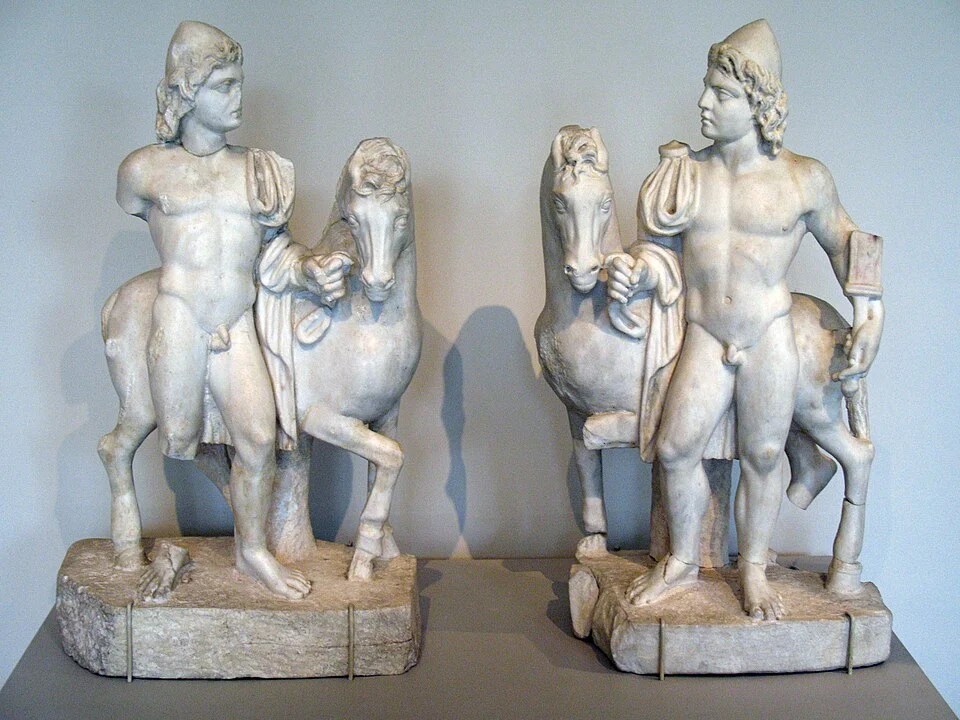
Among Leda’s children, none possess a stronger celestial identity than Castor and Polydeuces, collectively known as the Dioscuri.
In Greek tradition, the twins became protectors of sailors, warriors, and travellers. Their final transformation into the constellation Gemini made their association with the heavens explicit.
The traditions concerning their lives also provide an important chronological marker.
According to mythology, Castor and Polydeuces participated in the voyage of the Argo alongside Jason. Eusebius places the Argonautic expedition around 1266 BC.
If the Dioscuri were sufficiently mature to participate as warriors, their birth may reasonably be placed approximately twenty years earlier, around:
1285–1284 BC
This date is significant because it coincides with the proposed celestial catastrophe associated with Leda, Tyndareus, Pelops and Olympia.
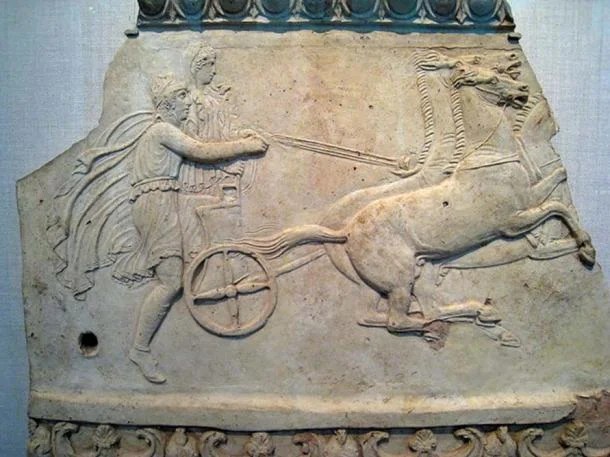
Date: 27 BCE–68 CE. The Met Fifth Avenue in Gallery 162
The chronological placement therefore provides an important connection between the miraculous birth of Leda’s children and the wider traditions surrounding a major event occurring around 1284 BC.
Castor: The Shining One
The name Castor has traditionally been connected with the Greek word for “beaver,” because such a lexical form existed in ancient Greek.
However, Pierre Chantraine (Dictionnaire étymologique de la langue grecque) also discusses a possible relationship with the verb:
kekasmai
meaning:
- to excel,
- to surpass,
- to shine.
Within this interpretation, Castor may be understood as:
“The Shining One”
“The Distinguished One”
The association is particularly appropriate given the later celestial identity of the Dioscuri.
Polydeuces: The Radiant Twin
The name Polydeuces is more difficult.
The first element, poly-, is clear and means “much” or “many.” The second element has generated considerable debate.
A traditional interpretation has attempted to connect deukes with sweetness, although this creates difficulties. In Homer, the related form adeukes means “bitter,” making the proposed meaning uncertain.
Another possibility has been to connect the name with a Proto-Indo-European root associated with brightness, although this remains disputed.
The mythology surrounding Polydeuces, however, consistently emphasizes brilliance.
In Apollonius Rhodius’ Argonautica (Book II), Polydeuces is compared to:
“a star of heaven, whose beams are most radiant at evening.”
This description is particularly important because it directly associates the hero with stellar brightness before his eventual placement among the stars as part of Gemini.
The mythology therefore preserves the idea of Polydeuces as a luminous figure regardless of the precise origin of his name.
11. The Doric Form: Polydaukes
An additional linguistic feature is the Doric form:
Polydaukes
This form is particularly relevant because Doric was the dialect spoken in Sparta, where the Dioscuri were especially important.
The difference between Polydeukes and Polydaukes reflects known dialect variation. In Doric Greek, certain vowel developments differ from Attic-Ionic forms, allowing the possibility of a broader pronunciation.
Within the interpretation proposed here, the form Polydaukes invites comparison with the Greek verb:
daio
meaning:
- to kindle,
- to burn,
- to set alight.
Related words include dais, meaning a blazing torch.
Under this interpretation, the name could suggest:
“He Who Burns with Great Fire”
“The Great Flashing Torch”
However, this derivation remains speculative. No major Greek etymological dictionary currently derives Polydeuces or Polydaukes from daio.
The importance of the observation therefore lies not in establishing a definitive etymology, but in recognising that the mythology itself repeatedly associates Polydeuces with brightness, fire, and stellar identity.
12. Olympia and the Celestial Event of c. 1284 BC
The traditions surrounding Leda reach their greatest significance when considered alongside the myths of Pelops and Olympia.
In previous studies, the present author has argued that a major celestial catastrophe occurred above Olympia around:
1284 BC
The event has been interpreted as a possible airburst or meteoritic phenomenon that affected the region.
Within this framework, the traditions concerning Leda and Pelops, although apparently separate, preserve related memories of the same extraordinary event.
The marriage of Leda and Tyndareus, the laying of the celestial egg, and the birth of Castor and Polydeuces are therefore placed within the same chronological horizon as the arrival of Pelops in Elis.
Rather than representing unrelated mythological episodes, these traditions may reflect different regional memories of a single catastrophic occurrence.
13. Leda and Pelops: Two Traditions, One Event
The geographical relationship between the traditions of Leda and Pelops is particularly important.
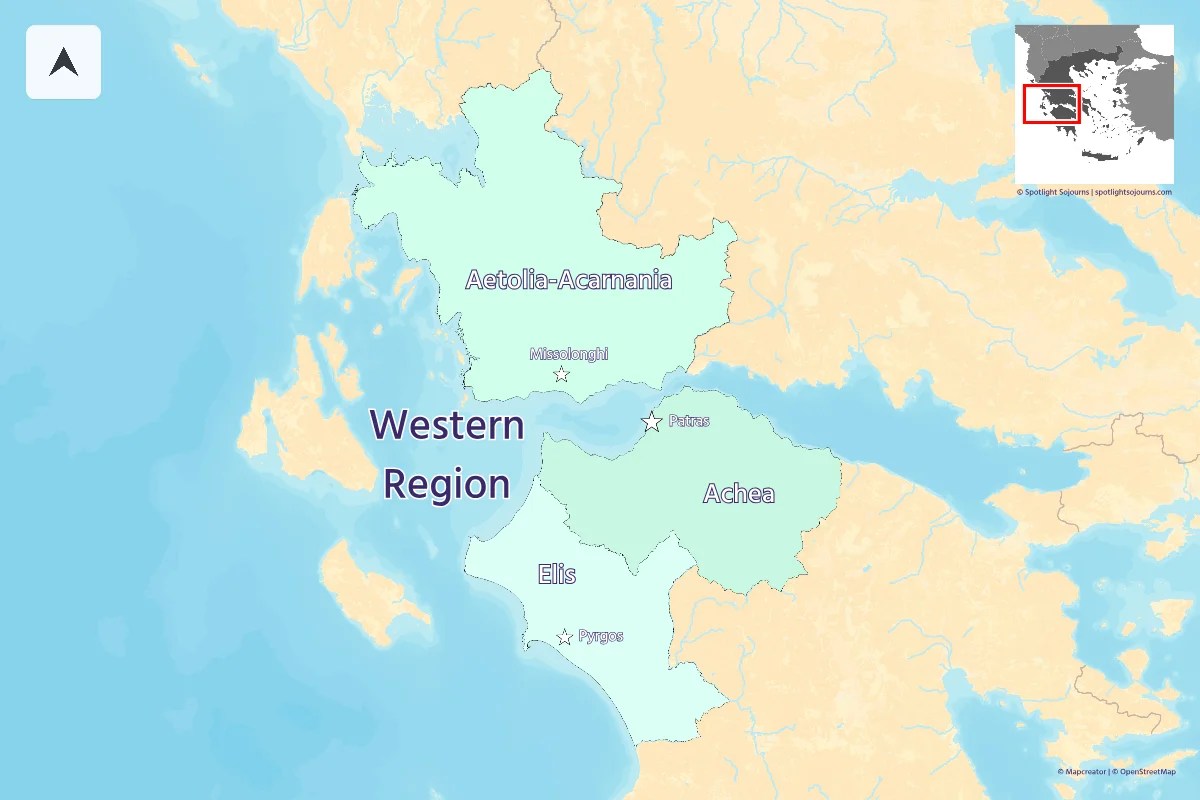
The ancient city of Pleuron, associated with Leda’s homeland in Aetolia, lies approximately:
55 kilometres (34 miles) from Ancient Olympia in a direct line across the Gulf of Corinth.
The ancient route connecting the regions, including the Sacred Way used for religious and athletic travel, followed a longer path of approximately:
57–58 kilometres (36 miles) through the surrounding landscape.
This distance is significant because a large atmospheric event occurring above Olympia could have been visible from Aetolia while communities there remained outside the most destructive area.
A catastrophe of this nature could therefore generate multiple traditions:
- one region preserving the memory of destruction and divine intervention,
- another preserving the memory of miraculous birth and transformation.
The later genealogical connection between the two traditions is also noteworthy.
Pelops became the ancestor of the Atreid dynasty, whose descendants included:
- Agamemnon,
- Menelaus.
Through marriage:
- Agamemnon married Clytemnestra,
- Menelaus married Helen,
both daughters of Leda.
Thus the descendants of Pelops and Leda became permanently united within the mythology of the Trojan War.
This connection suggests that Greek tradition did not preserve these genealogies as isolated stories. Instead, separate regional memories were woven together into a single heroic chronology.
by Marilee Kostadimas
Conclusion
The traditions surrounding Leda present a complex mixture of genealogy, symbolism, chronology, and celestial imagery.
Later sources commonly identify somebody called Thestius as her father, yet earlier traditions preserved by Eumelus and Alcman connect her directly to Glaucus, son of Sisyphus. Within the chronological framework adopted throughout this series, this earlier genealogy represents not simply a family relationship but a symbolic sequence connecting successive celestial phenomena.
Sisyphus and Glaucus correspond to earlier apparitions of Halley’s Comet in approximately 1404 BC and 1334 BC. Leda, however, belongs to a different category. The traditions surrounding her marriage, her egg, her children, and her connection with Olympia preserve the memory of a separate celestial catastrophe occurring around:
1284 BC
The evidence presented here does not depend upon a single argument. The interpretation emerges from the convergence of several independent strands:
- early alternative genealogies,
- chronological difficulties within heroic succession,
- names associated with radiance and destruction,
- celestial symbolism involving birds, eggs, horses, and stars,
- the stellar identity of Castor and Polydeuces,
- and the geographical relationship between Aetolia and Olympia.
None of these elements alone proves that the Leda tradition preserves a memory of a celestial event. However, collectively they suggest that the mythology may preserve more than a heroic genealogy.
Within the reconstruction proposed here, Leda represents not merely the mother of Helen and the Dioscuri, but the mythological personification of a major celestial occurrence whose memory survived through generations of storytelling.
The swan, the egg, the radiant twins, the shining Glaucus, and the traditions surrounding Olympia may therefore be understood as interconnected reflections of an extraordinary event observed in the Late Bronze Age.
Rather than being random inventions of mythological imagination, these traditions may preserve the distant memory of a moment when the heavens themselves became part of human history.
NEXT: Helen of Troy- a celestial metaphor?
Bibliography
Alcman. Fragments.
Apollonius Rhodius. Argonautica.
Brada?, Marina Mili?evi?. “Greek Mythological Horses and the World’s Boundary.” 2001.
Chantraine, Pierre. Dictionnaire étymologique de la langue grecque.
Eratosthenes. Chronological traditions concerning the Fall of Troy.
Eumelus of Corinth. Corinthiaca (fragments preserved in scholia).
Eusebius. Chronicon.
Etymologicum Magnum.
Homeric Hymn 32.
Nikolaev, Alexander. Indo-European Linguistics and Classical Philology 29/2 (2025): 107–136.
Puhvel, Jaan. Analecta Indoeuropaea: Delectus Operum Minorum. 1981.
Plato. Cratylus.
Scholia on Apollonius Rhodius, Argonautica.
Leave a Reply